Why FNAF is one of my favourite horror games
Nov 24, 2025·7 min read
"I always come back." ~ William Afton
Most horror games try to impress you with movement. Big spaces. Big monsters. Big freedom. Five Nights at Freddy’s does something more embarrassing for the player: it takes your freedom away and then watches you negotiate with your own imagination.
You don’t “explore” the horror. You host it.
You sit in a cheap office with cheap lighting and expensive dread, and the game’s core mechanic is basically: cope. Cope with limited information, cope with unreliable routines, cope with your brain doing threat-modeling at 2 a.m. like it’s submitting a paper to Nature.
That’s the first reason I love FNAF: it’s horror without the usual theatrics. No cinematic chase sequences to dilute the fear into adrenaline. Just you, a set of rules that don’t love you back, and animatronics that feel like a childhood mascot got possessed by an IT ticket marked “urgent.”
There’s something deeply uncomfortable about being forced to sit still while danger approaches. Every other game lets you run, hide, fight back. FNAF says: no, you’ll stay exactly where you are, and you’ll watch it come for you. The only agency you have is closing doors and checking cameras, actions that feel less like strategy and more like prayer.
#The lore that rewards obsession
FNAF’s lore is engineered like a puzzle box that wants to be opened, but refuses to be solved politely. It’s not just “hidden story.” It’s story as an ecosystem: tiny clues, recurring motifs, contradictory evidence, and that specific flavor of ambiguity where the uncertainty feels intentional rather than sloppy.
The proof is what it did to people: the culture around decoding it became its own side-quest. Theory channels, wiki rabbit holes, comment sections that turn into courtroom debates, FNAF didn’t just give players a plot. It gave them a reason to argue about reality.
And it wasn’t “one neat mystery.” It was layered, recursive, and occasionally cruel. You’d finally feel like you understood one thing, and the next game would nudge that certainty off a cliff. The story wasn’t window dressing. It was the other half of the experience: an invitation to work.
Take the Bite discourse[1]. For years, the community lived inside that question like it was rent-free housing. A bite in 1987 gets referenced. Then a bite in 1983 gets shown. So which one mattered? Which one was the infamous one? People split into camps, wrote essays, mapped timelines that looked like conspiracy boards. And the game never rewarded you with a clean, corporate “FAQ: Here’s what happened.” It rewarded you with inference, uncertainty, and the feeling that you earned your understanding the hard way.
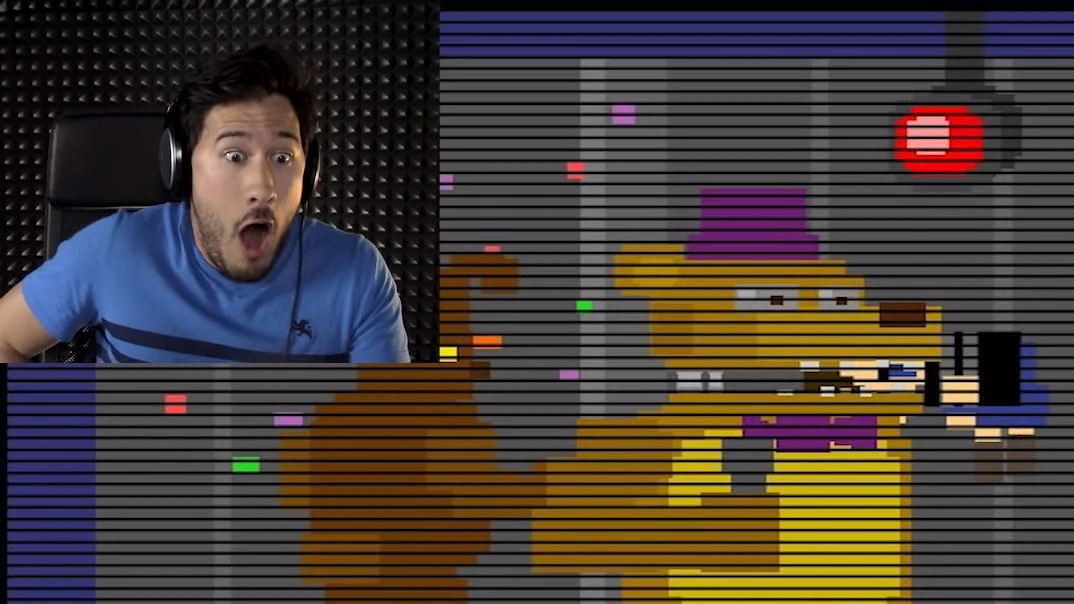
Same thing with the Purple Guy saga: early on, he’s not even a person, just an omen in sprite form. Then the series slowly forces him into being a character, then a history, then a family, then a multi-game contamination that refuses to stay dead. Even when names appear later and the lore “clarifies,” it also expands sideways, introducing enough new machinery (remnant, scooping, identity overlaps, bodies-as-vessels horror) that your tidy explanation turns back into a mess.
But I still like the way it treats lore as a living thing. It closes chapters while leaving arteries open. It gives you resolution without sterilizing the world. Even when it “concludes,” it leaves behind a future-shaped shadow, enough to make you keep looking.
#The four-game run that keeps tightening
FNAF 1 to 4 is the run I keep coming back to. It’s the cleanest expression of the idea: “What if horror was a desk job?”
And YouTube mattered[2]. Markiplier’s playthroughs weren’t just entertainment; they were an onboarding funnel for obsession. He turned fear into a ritual. New upload drops, new night attempted, new tiny revelation, new breakdown of strategies and lore findings. The games became social. Not multiplayer, worse. Collective anxiety.
I remember the exact feeling: refreshing YouTube after school, seeing that thumbnail with Mark’s face mid-scream, knowing I was about to watch him suffer for twenty minutes while I sat safely on the other side of the screen. And somehow that still scared me. FNAF didn’t need me to play it to get under my skin. Watching someone else navigate that specific hell was enough.
But then, of course, I had to try it myself. Because watching someone else get jumpscared and doing it yourself are two completely different psychological experiences. One is voyeuristic. The other is accountability.
FNAF 1 is brutal in its simplicity. Stationary viewpoint, fixed cameras, limited power, and an ever-tightening loop of checking, deciding, and praying your last action wasn’t the wrong one. It drops you straight into the problem. No tutorial that pampers you. Just the phone guy giving you the kind of guidance that feels like a coworker who already quit emotionally.
That “strapped to the seat” feeling is the point. The animatronics aren’t scary because they’re fast. They’re scary because you can’t meaningfully escape. You’re managing a system that’s decaying in real time.
The first time Freddy’s jingle played while I was scrambling to check Pirate Cove, I think my brain just stopped. Like it couldn't process both threats at once and decided to blue-screen instead. That’s the elegance of FNAF 1: it doesn’t overwhelm you with information. It starves you of it, then makes you choose what to ignore.
FNAF 2 adds chaos, but in a way that’s weirdly comedic. The ambience, those hall sounds, that dead air, became meme fuel because it’s so specific. The mask mechanic is an elegant twist: it changes the fear from “monitoring distance” to “performing correctness.” Put the mask on too late, you die. Put it on too long, you lose tempo. The tension becomes procedural, like you’re doing a checklist under fire.
And yes, the difficulty spike can feel rude, especially when randomness creeps in. Toy Bonnie (and friends) sometimes feels less like an enemy and more like an unpredictable timer attached to your nervous system. But it’s also refreshing: the game forces you to learn rhythm, not just rules.
FNAF 3 is the weird one in the best way. It tried to be an ending, or at least present itself as closure, but it also felt like the series learning that answers are addictive and ambiguity is profitable. The premise is tighter: one main threat, a decayed attraction vibe, the sense of history turned into entertainment. And yet it leaves you with that classic FNAF experience: you finish a night and feel less sure you understand what you just survived.
There’s something poetic about its setting too. You’re in an attraction about the horror that happened before. It collapses the distance between player and fiction: you’re a consumer of the trauma, inside a world that’s literally commodified it.
FNAF 4 is my favorite because it shifts the interface from vision to listening. It doesn’t just add a mechanic; it changes what kind of player you need to be. You stop scanning monitors and start parsing micro-signals: breathing, footsteps, silence that feels staged. Audio cues turn fear into a cognitive task. You’re not reacting to what you see; you’re interpreting what you think you heard, under pressure, while your imagination tries to sabotage your confidence.
These two videos[3][4] dig into the audio angle in more detail, and I agree with them.
Audio horror is intimate. Sound bypasses your analytical layer and goes straight to the animal part of your brain. FNAF 4 makes that animal part do accounting. When you press your ear to a door and hear maybe-breathing, maybe-nothing, your entire body becomes an antenna. You’re not playing a game anymore. You’re trying to survive a sensory puzzle where wrong interpretations are fatal.
It’s also the game where “being wrong” feels personal. In earlier games, you lose because you missed a camera check or mismanaged power. In FNAF 4, you lose because your perception failed. You trusted the wrong silence. You doubted the right cue. That’s a different kind of dread, less arcade, more psychological.
#Childhood, weaponized (kindly)
A lot of FNAF’s power comes from how it corrupts childhood aesthetics: mascots, birthday parties, bright characters designed to be safe. That’s already unsettling. But for me it’s layered with something simpler: memory.
Coming home from school, opening YouTube, waiting for the next Markiplier upload, especially around the Sister Location era, felt like a routine that made time feel slower in the best way. That’s the bittersweet trick: you can replay the games, but you can’t replay the version of yourself who had nothing to do except be excited for a video.
There’s a specific kind of peace in having your biggest “problem” be whether you’ll survive Night 5. Not because the stakes are real, but because they feel real inside the safe container of your room, your screen, your after-school hours before dinner. The world was small enough that FNAF could fill it.
#Appendix
The 'Bite' Discourse
The "Bite of '87" vs "Bite of '83" is perhaps the most famous example of Scott Cawthon using small details to upend community certainty. It turned a simple background detail into a foundational mystery that required players to frame-count mini-games and pixel-hunt for clues in source code.
Audio as Epistemic Pressure
What I like most about this video is that it frames audio not as “immersion,” but as epistemic pressure. You are not reacting to danger, you are inferring it. The horror comes from uncertainty, not surprise. That aligns perfectly with why FNAF 4 feels so mentally exhausting. You are constantly updating a fragile internal model of the world with incomplete data.
The Proximity of Sound
This second video goes deeper into why this works specifically in horror games, and it nails something crucial: sound collapses distance in a way visuals do not. A visual threat has a location. An audio threat has intent. Hearing breathing behind a door feels invasive because it implies proximity without confirmation. Your brain treats it as something already inside your personal space. That’s why FNAF 4’s silence is often scarier than its noise. Silence isn’t absence of information, it’s delayed information.